Oct 7, 2025 / 6 min read
Organizational systems
The Spectrums of Organizational Entropy
This physical law provides the perfect analogy for understanding the complex web of organizational challenges illustrated in the concept of “debt.” We often talk about “technical…

As a science graduate, I’m always impressed by the beauty of nature and the fundamental laws that govern it. From the elegant orbits of planets to the intricate dance of molecules, there are universal principles at play. One of the most profound is the Second Law of Thermodynamics, which describes a concept we all intuitively understand: Entropy. It is the universe’s relentless, unwavering march towards disorder. A hot cup of coffee always cools; a tidy room, left alone, becomes messy. Without a constant, deliberate input of energy, systems naturally decay into chaos.
This physical law provides the perfect analogy for understanding the complex web of organizational challenges illustrated in the concept of “debt.” We often talk about “technical debt,” but this is merely one symptom of a much larger, systemic force. The various “debts” — be they in technology, process, culture, skill, or data — are not isolated problems. They are the visible manifestations of organizational entropy. The true “root cause” is not a single bad decision, but the failure to continuously invest the strategic energy required to counteract this natural slide into disorder.
The Spectrums of Organizational Entropy: Deconstructing the Debts
Just as entropy can manifest in different ways — a rusting car, a decaying log — organizational entropy appears across various domains. Viewing these “debts” through the lens of physics helps us see them not as moral failings, but as predictable outcomes in a complex system.
- Technology Debt: This is the most literal form of decay. Legacy systems, disjointed functions, and escalating maintenance costs are the organizational equivalent of metal fatigue and corrosion. By choosing short-term speed over long-term reliability, we allow the core infrastructure to rust, knowing that a structural failure is inevitable. This creates a system that requires more and more energy just to maintain its current state, leaving little for growth.
- Data Debt: Information, like energy, tends to dissipate. When data is trapped in silos, stored in inconsistent patterns, or disseminated poorly, it loses its potential. It becomes informational noise rather than a source of strategic insight. The organization effectively becomes dumber, unable to learn from its own experience because its “memories” are fragmented and disordered.
- Process Debt: This represents friction and wasted energy. Operational silos, convoluted workflows, and unnecessary structural complexities are all signs that the pathways for work are breaking down. Each redundant step or communication bottleneck is a point where valuable energy — in the form of time, effort, and capital — is lost as heat, never contributing to productive output.
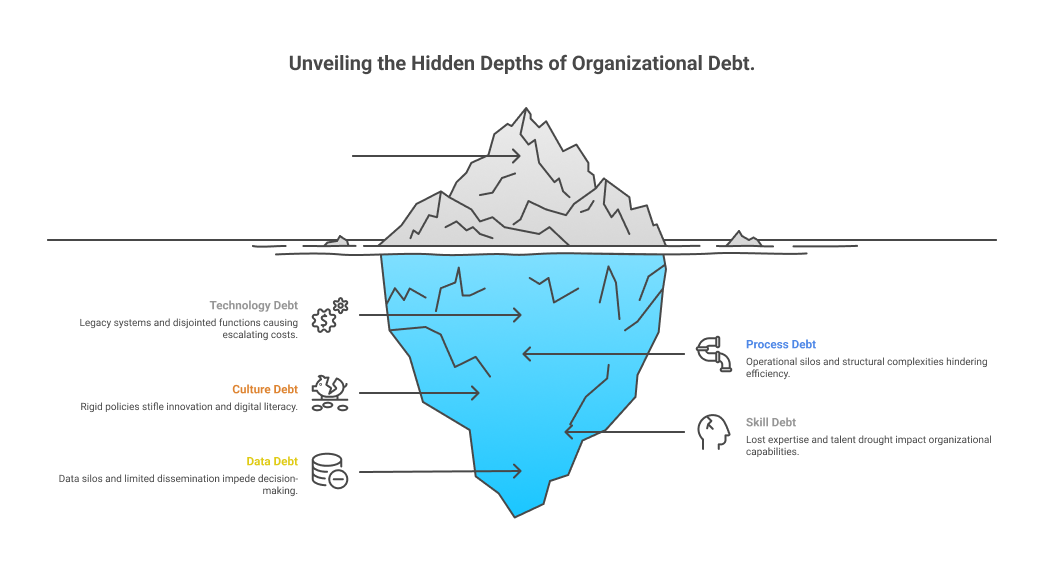
- Skill Debt: Entropy also applies to human capital. When expertise is lost and not replaced, when a talent drought emerges, or when structural rigidity prevents growth, the organization’s collective intelligence degrades. This is a critical failure, as an organization’s primary weapon against entropy is the focused, creative energy of its people. As I’ve explored before, your income is ultimately the market value of your skill set; for an organization, its value is the sum of its collective skills.
- Culture Debt: Perhaps the most dangerous form of entropy is the decay of the social fabric. Rigid policies, a lack of innovation incentives, and poor leadership create an environment of low trust and fear. This dissipates the psychological energy that fuels collaboration and motivation. Without this binding force, even the most talented individuals operate in a state of chaos, their efforts uncoordinated and misaligned.
The Engine of Decay: Why Entropy Takes Hold
If organizational decay is a natural tendency, then a healthy organization must be in a constant state of fighting it. The “root cause of debts” is the failure of this fight. This failure isn’t accidental; it stems from deeply ingrained biases and flawed strategic models.
- The Tyranny of the Immediate (Second-Order Thinking): Leaders often prioritize short-term outputs over long-term stability. The push to “deliver fast” without considering the entropic cost is a classic failure of Second-Order Thinking. We solve today’s visible problem by creating a larger, invisible one for tomorrow. This leads to a cycle where we are perpetually “solving” problems that are, in fact, symptoms of the debt we willingly incurred.
- Misaligned Incentives: Our systems often reward the wrong behavior. We celebrate the hero who works all weekend to fix a system crash (a visible problem) but overlook the quiet engineer who spends weeks meticulously refactoring code to prevent future crashes. As a result, our Incentives encourage firefighting rather than fire prevention, rewarding those who react to chaos rather than those who create order.
- System Inertia (Activation Energy & Status Quo Bias): Overcoming entropy requires a significant upfront investment of energy, a concept known in chemistry as Activation Energy. Refactoring a legacy system, retraining a team, or redesigning a core process demands immense effort. Faced with this, the Status Quo Bias kicks in. It feels easier and safer to apply another patch, to live with the known disorder, than to muster the energy for a fundamental change.
The Inevitable Collapse: From Debt to Break Points
Entropy is a cumulative force. Each piece of unresolved debt adds to the system’s total disorder. The debts are interconnected; a rusting technological core (tech debt) forces convoluted workarounds (process debt), which frustrates and drives away talented employees (skill debt), creating a culture of cynicism (culture debt).
This is a clear example of Systems Thinking: a failure in one area cascades and amplifies failures in others. The organization runs hotter and hotter, burning energy on internal friction until it reaches a Critical Mass. At this stage, the system hits a Break Point. Gradual decay transforms into sudden, catastrophic failure. Key employees burn out and quit, citing a fundamental “Effort:Reward Imbalance.” Customer trust evaporates after a major outage. The product, once innovative, becomes irrelevant, unable to adapt. The system collapses under the weight of its own accumulated disorder.
The Philosophical Mandate: Leadership as an Anti-Entropic Force
Returning to our analogy, the Second Law of Thermodynamics is not a suggestion; it is a fundamental law of reality. The default state of any system is decay. Therefore, the most essential function of leadership, strategy, and good management is to serve as a constant, anti-entropic force.
The goal is not to build an organization that never accrues debt — an impossible task akin to halting time. Rather, the goal is to build an organization that is profoundly aware of the forces of entropy and is architected to continuously counteract them. This requires a shift in perspective. Building wealth is not just about financial accumulation; it is about building order and value. This means investing in intellectual wealth (skills), social wealth (culture), and structural wealth (technology and processes).
The “root cause of debts,” then, is a failure of strategic energy. It is a failure to see the organization as a living system that requires constant care, investment, and intention to keep it from sliding into the chaos that is its natural destination. A great organization doesn’t just happen. It is a triumph of design and will — a beautifully complex, ordered system carved out and maintained in a universe that defaults to disorder.