Jan 20, 2026 / 5 min read
Strategy discipline
The Illusion of the Shiny Object
In the startup ecosystem, we often mistake the flash of Pyrite for the value of Gold. Just as the 13th-century poet Yunus Emre profoundly warned centuries ago:
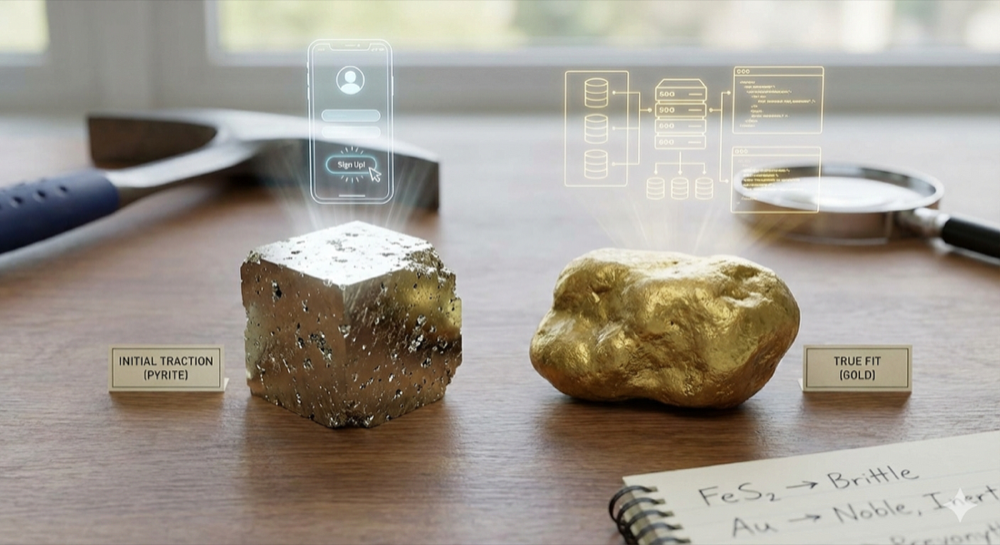
As a science graduate, I’m always impressed by the beauty of nature, but also by its deceptive complexity. One of the first lessons in geology is the distinction between Iron Pyrite (FeS2) and Gold (Au). Pyrite, commonly known as “Fool’s Gold,” forms beautiful, perfect cubic crystals. It glitters brilliantly under the sun, often brighter than gold itself. To the untrained eye, it is captivating. However, Pyrite is brittle; strike it, and it shatters. Worse, when exposed to moisture and air, it reacts to form sulfuric acid, destroying itself and the surrounding rock. Gold, conversely, is a noble metal. It is chemically inert, highly conductive, and malleable. It doesn’t rely on a temporary shine; it relies on atomic stability.
In the startup ecosystem, we often mistake the flash of Pyrite for the value of Gold. Just as the 13th-century poet Yunus Emre profoundly warned centuries ago:
“Those who do not know the value of jewels mistake this stone for a bead, give it away for free, and do not know what they sold it for.”
We, too, often mistake the stone for the bead, giving away our true value, our time, resources, and potential for free. We confuse “initial traction” with “Product-Market Fit.” We see a “shiny object” a new tool, a new framework, or a new potential partner, and we are seduced by the novelty. But as we analyze the physics of product reliability, we must ask: Is this a foundational element, or just a brittle crystal waiting to shatter under pressure?
Signaling and Hyperbolic Discounting
When users encounter a new product with a sleek interface and grand promises, the immediate reaction is biological. The interface is shiny, the colors are perfect, and the “Sign Up” button offers a promise of a better future. The user signs up, and the metrics spike.
However, we must view this through the mental model of Hyperbolic Discounting. We naturally value immediate, short-term rewards (the thrill of the new UI) over long-term, sustainable value (reliability and uptime). This is not “fit”; this is a dopamine hit.
In product management, we often see that “speed without quality leads to product/design/engineering debt, instability, and rework”. The shiny object effectively “signals” value without necessarily possessing the underlying infrastructure to deliver it. This is Signalling Theory in action, a peacock’s tail that looks impressive but might hamper flight. The user feels a connection, but does the product actually solve the user’s core pain point when the server crashes at 3 AM? Usually, the shiny object is just a wrapper with no backend.
Demo vs. Reality: Surviving the Edge Cases
Beware of the “Demo Trap.” Every product looks perfect in a controlled environment, much like Pyrite looks perfect in a museum display case. In a demo, there are no “edge cases”, no unexpected traffic spikes, no legacy code integration, and no complex user demands.
However, reality is governed by Murphy’s Law and Entropy. Systems tend toward disorder. When a user integrates a new product into their actual workflow (or life), they are introducing complex variables. This is where we must apply Second-Order Thinking. We cannot just ask, “How does it look now?” We must ask, “What happens when the load doubles?”
“Delivering reliably means consistently shipping software that works as expected, meets requirements, and maintains stability over time”. A shiny tool might look great for a weekend project, but can it handle the legacy code, the unexpected bugs, and the heavy maintenance of a scaling enterprise? Usually, users realize too late that they traded a robust, full-stack solution for a shallow app that drains the battery.
The Law of Diminishing Returns
True value isn’t about the thrill of the purchase; it’s about the ease of operation. When a product lacks a solid foundation, the user is forced to bridge the gap. They have to fix the product’s errors, create workarounds for its limitations, or constantly restart it.
This dynamic creates a negative feedback loop explained by Loss Aversion. The user has invested time (sunk cost) and keeps trying to make the shiny object work, even as the return on their effort diminishes.
- The Hidden Cost: “The cumulative cost per worker per year due to productivity losses resulting from communication barriers is $26,041”. Similarly, a buggy, unreliable product creates massive hidden costs in downtime and frustration.
- The Churn: We see this often: A client leaves a stable provider for a flashy newcomer. Two months later, they return. Why? Because the shiny object didn’t have customer support. It didn’t have resilience. It was just… shiny.
If a user has to constantly fix the product or guide it, the Net Promoter Score (NPS) drops to zero. A product should reduce the user’s cognitive load, not add to it.
Conclusion: Reliability is the Noble Metal
In the long run, the market is efficient. It eventually distinguishes between the brittle Pyrite and the enduring Gold. Don’t confuse a “feature” with a “partner.” A feature entertains you for a moment; a partner scales with you.
As leaders and product builders, we must look past the dazzling UI and inspect the code. We must value the boring, invisible attributes of stability and “predictable releases with minimal disruptions”. Because when the hype fades, and it always does, you are left with the reality.
In a world of shiny objects, “reliability outperforms speed”. It is the sexiest feature of all because it is the only one that remains when the pressure is applied.