Aug 29, 2025 / 4 min read
Strategy discipline
Software Economics 401
Our study began by identifying the components of a system (101), progressed to understanding their internal strategic interplay (201), and expanded to see how they adapt to external…

As a science graduate, I’m always impressed by the beauty of nature.
The Terraforming Thesis — Capex, Opex, and Societal Restructuring
Our study began by identifying the components of a system (101), progressed to understanding their internal strategic interplay (201), and expanded to see how they adapt to external macroeconomic weather (301). In this final thesis, we must address the ultimate consequence of these activities. We must acknowledge that the capital allocation decisions of today’s largest technology firms are no longer just business strategies; they are acts of social engineering. The scale of modern Capex and Opex has grown so vast that these companies are no longer just operating within the global ecosystem. They are now terraforming it.
This is the final stage of our understanding: to see that the world’s most powerful corporations are not just building products, but are fundamentally restructuring the landscape of human society, interaction, and value itself. The balance sheet has become a blueprint for a new world.
From Market Creation to Reality Creation
Historically, Capital Expenditure was an investment to build the means of production within an existing reality. You built a factory (Capex) to produce cars for people who already lived in cities and drove on roads. The goal was to serve or expand a known market.
The terraforming thesis posits that modern, hyper-scale Capex has a new function: reality creation.
- The Terraforming Engine: When a company like Meta allocates over $100 billion in Capex towards the Metaverse, it is not serving an existing market. It is spending a sum larger than the GDP of many nations to will an entirely new reality into existence. Similarly, the colossal Capex from Microsoft, Google, and others to build Artificial General Intelligence is not an investment to improve an existing product line; it is a foundational expenditure to create a new form of non-human intelligence that will permanently alter our world. This is not market expansion; it is an attempt to architect the very substrate of future human experience.
Opex as the New Social Contract
If Capex is the tool for building new worlds, Opex is the set of laws that govern them. The operational costs of running these global-scale platforms are funded by business models that actively and continuously shape human behavior.
- The Attention Economy: The massive Opex required to run platforms like TikTok, YouTube, and Instagram — the endless server farms, content moderation, and algorithmic tuning — is primarily funded by advertising. This creates a de facto social contract where the price of “free” access is our attention. The platform’s operational imperative is to maximize engagement, which has led to algorithms that can inadvertently promote addiction, social anxiety, and polarization. The Opex is not a neutral background cost; it is an active force shaping public discourse and individual psychology.
- The Subscription Society: The inexorable shift to Opex-heavy SaaS models for everything from productivity (Microsoft 365) to entertainment (Netflix) has rewritten the rules of ownership. We are becoming a society of perpetual renters, where access to essential tools and culture is contingent upon an unending stream of operational payments. This creates immense, sticky revenue streams, but it also concentrates power, making a few global firms the landlords of our digital lives.
The Ethical Mandate: Acknowledging “Societal Debt”
In our 201 course, we discussed how ignoring needed refactors creates technical debt. At the 401 level, we must introduce a far more critical concept: Societal Debt.
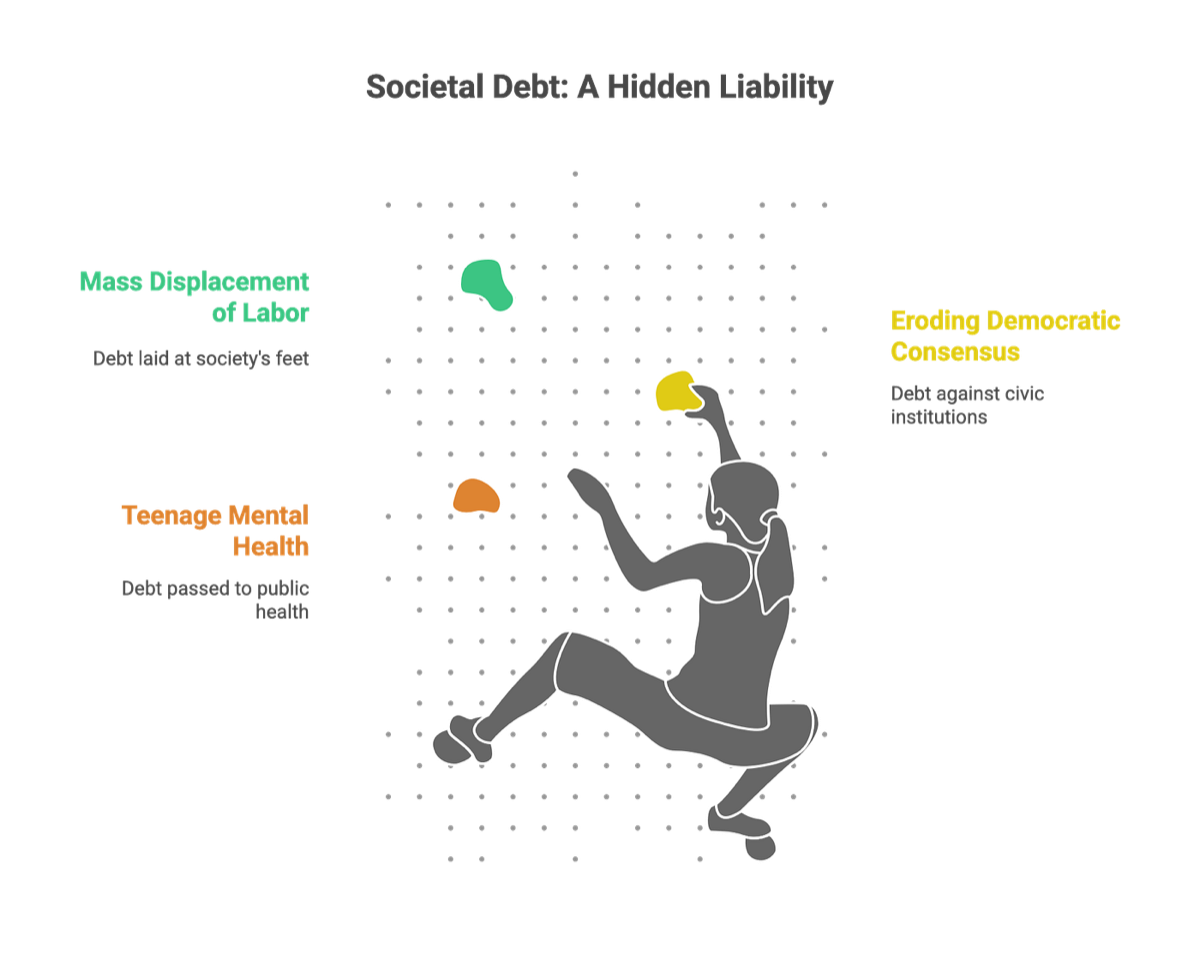
Societal Debt is the accumulated, unaccounted-for negative externalities that result from capital allocation decisions optimized purely for financial return. By focusing exclusively on financial Capex and Opex while ignoring the social and ethical impact, companies are accumulating a hidden, off-balance-sheet liability of staggering proportions.
Examples of Societal Debt:
- The decline in teenage mental health, strongly correlated with the rise of algorithmically-driven social media, is a debt passed on to our public health systems.
- The erosion of democratic consensus, accelerated by the viral spread of misinformation optimized for engagement, is a debt against our civic institutions.
- The looming mass displacement of labor due to AI, the direct result of the current AI Capex/Opex cycle, is a future debt that will be laid at the feet of society to solve.
The 401-level question is not “what is the ROI of this investment?” but “Who is responsible for pricing these externalities, and who will ultimately pay this debt?”
Conclusion: Beyond the Balance Sheet
We have traced the flow of capital from a simple accounting entry (101), to a tool of corporate strategy (201), to a response to macroeconomic forces (301). Finally, we see it in its ultimate form: the primary force shaping the future of human society (401).
The final responsibility of a leader in this new era transcends that of an architect, ecologist, or even a meteorologist. The role must now be that of an ethicist — one who recognizes that every major capital investment is an ethical choice about the kind of world we are building. When the power to allocate capital becomes the power to terraform society, the line items on a balance sheet cease to be mere numbers. They become moral statements.