Aug 20, 2025 / 4 min read
Strategy discipline
Software Economics 201
In an introductory course, we learn to identify the individual components of an ecosystem: the river, the forest, the soil. But in advanced study, we learn that the true…

As a science graduate, I’m always impressed by the beauty of nature.
The Strategic Interplay of Capex and Opex
In an introductory course, we learn to identify the individual components of an ecosystem: the river, the forest, the soil. But in advanced study, we learn that the true understanding comes from observing their interplay — how the river’s flow nourishes the forest, and how the forest’s roots anchor the soil, preventing the river from washing it away. This is a dynamic, interdependent system.
Having moved past the simple definitions of Capital and Operational Expenditures from our 101 course, we now explore their strategic interplay. The crucial insight is that Capex and Opex are not just accounting categories; they are interdependent forces that shape your company’s strategy, agility, and long-term viability. How you manage the flow between them determines the health of your entire business ecosystem.
The Blurry Line: Capitalization as a Strategic Tool
In our 101 course, the distinction was simple: building things is Capex, running things is Opex. The 201-level reality is more nuanced, hinging on a concept called capitalized software development.
Under accounting standards (like ASC 350–40), a portion of your largest Opex category — developer salaries — can be reclassified as Capex. This is not merely an accounting trick; it’s a statement of intent. The guiding question is: “Is this work creating a new, long-term asset, or is it maintaining an existing one?”
- Work classified as Capex: Building a new microservices platform from scratch, developing a major new feature set that unlocks a new market, or a significant architectural refactor that will provide benefits for years. This is akin to building a dam to create a reservoir — a foundational investment in future capability.
- Work that remains Opex: Fixing bugs, performing routine maintenance, making minor iterative improvements, or early-stage research that doesn’t yet have a defined outcome. This is managing the river’s daily flow.
The strategic decision of what to capitalize reflects what you consider a foundational investment versus a routine operational cost.
The Trade-Offs: A Game of Agility vs. Defensibility
Viewing Capex and Opex as strategic levers reveals a fascinating game of trade-offs, where every choice impacts your competitive position.
- The Opex-Dominant Strategy (The Cloud & SaaS Model): By leveraging cloud services and third-party SaaS tools, you keep your Capex low. This grants you immense agility. You can scale, pivot, and experiment with minimal upfront commitment. However, this ecosystem is built on rented land. Your competitive moat is shallower because competitors can assemble a similar stack of services. It is a game of speed and operational excellence.
- The Capex-Dominant Strategy (The Proprietary Platform Model): By making a significant Capex investment in a unique, proprietary platform, you build a powerful competitive moat. Your technology becomes a defensible asset that is difficult and expensive for others to replicate. The trade-off is a loss of agility. This large investment locks you into a specific path and makes pivoting costly. It is a game of long-term vision and entrenchment.
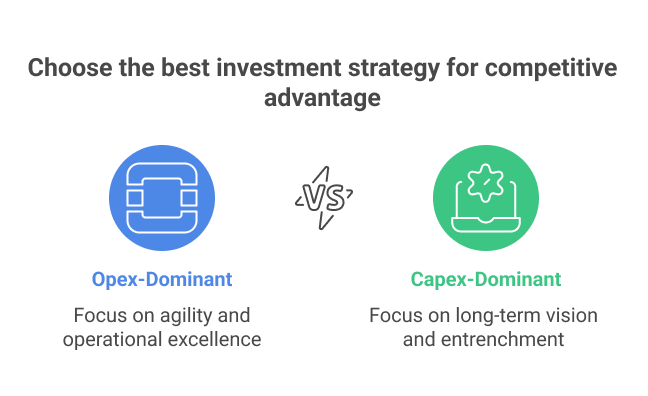
A mature company learns to play both games, using its Opex-driven agility to explore new territories while making targeted Capex investments to fortify the areas it decides to own.
Financial Implications Beyond the Income Statement
The strategic choices between Capex and Opex have profound effects on how your company is valued and its long-term financial health.
- Valuation Models: Investors analyze these expenditures differently.
- An Opex-heavy SaaS business is often valued based on a multiple of its Annual Recurring Revenue (ARR), as its predictable operational costs are seen as directly fueling revenue growth.
- A business with heavy Capex is often analyzed based on its EBITDA (Earnings Before Interest, Taxes, Depreciation, and Amortization). Amortization (the Capex equivalent of depreciation) is added back to earnings because the initial cash outlay is a past investment, not a current operational cost.
- Technical Debt as Off-Balance-Sheet Debt: Here we find the most critical connection. Technical debt is the result of choosing a short-term, low-cost solution (saving Opex now) at the expense of long-term health. A proper refactor to fix this would be a Capex-style investment. By continually choosing the “Opex-saving” path, you accumulate a hidden liability that doesn’t appear on the balance sheet but acts like a debt, demanding ever-increasing “interest payments” in the form of slower development and higher maintenance costs (inflated Opex).
Conclusion: Cultivating a Resilient Ecosystem
Moving beyond a 101-level understanding requires us to stop seeing Capex and Opex as static buckets. Instead, we must view them as a dynamic, flowing system. The goal of a sophisticated leader is not simply to build a product, but to cultivate a resilient business ecosystem.
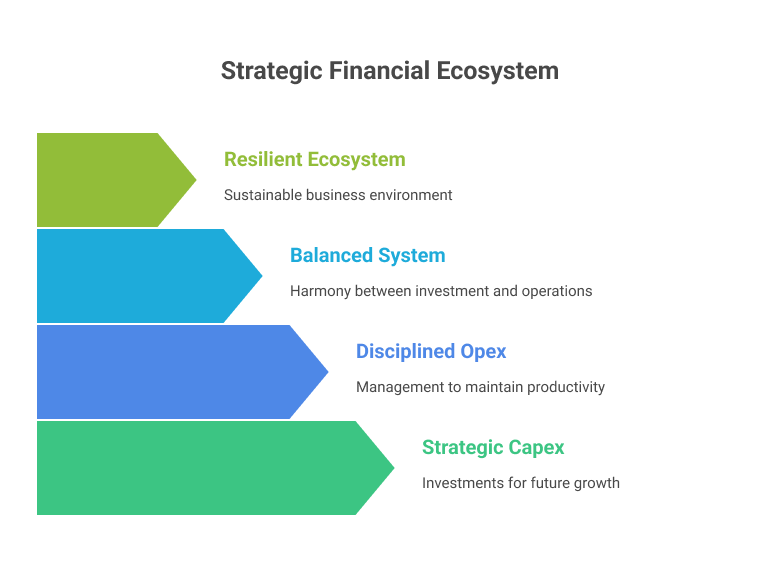
You make strategic Capex investments to create new fertile ground. You then manage your Opex with discipline to ensure that ground remains healthy and productive. Pushing too hard on one lever throws the entire system out of balance. The ultimate measure of success is the ability to strategically invest in the future while maintaining the operational health of the present.