Jun 26, 2023 / 4 min read
Systems essays
Problem-solving is misunderstood
In today’s world, we encounter individuals with both soft and hard skill sets. We naturally learn, and circumstances compel us to further develop these skills. When the environment…

As a science graduate, I’m always impressed by the beauty of nature…
Skills
In today’s world, we encounter individuals with both soft and hard skill sets. We naturally learn, and circumstances compel us to further develop these skills. When the environment does not afford us sufficient time for reasoning, we learn through experiences, whether positive or negative. These experiences may be our own or those of the people around us. While learning through personal experimentation and failures is relatively straightforward, we often learn from others as well. This reliance on others is necessary since we cannot acquire knowledge in all areas independently. When individuals choose the wrong role model and lack time for reasoning, they may experience failure or adopt incorrect behaviors and models. Throughout history, many lives were lost due to weakened body strength as it took significant time to realize that bloodletting is not an effective means of curing patients. To enhance our skills, we can draw lessons from philosophy.
Philosophical look at learning
Empiricist philosophers, such as David Hume, John Locke, and Francis Bacon, argue that all knowledge is derived from and verified through experimental evidence. They place primary emphasis on sensory experience and observation as the foundation of knowledge. While I appreciate their explanations, I find Aristotle’s approach, which dates back approximately 2500 years, to be the most compelling. Aristotle made significant contributions to the study of reasoning and logic. He developed a system of deductive reasoning known as syllogism, which forms the foundation of formal logic. Syllogism is a method of drawing conclusions from two premises by means of a logical argument consisting of a major premise, a minor premise, and a conclusion. Aristotle’s work on logic provided a framework for analyzing and evaluating arguments, greatly influencing subsequent philosophical and scientific thinking.
Let’s examine some examples and remember how reasoning works.
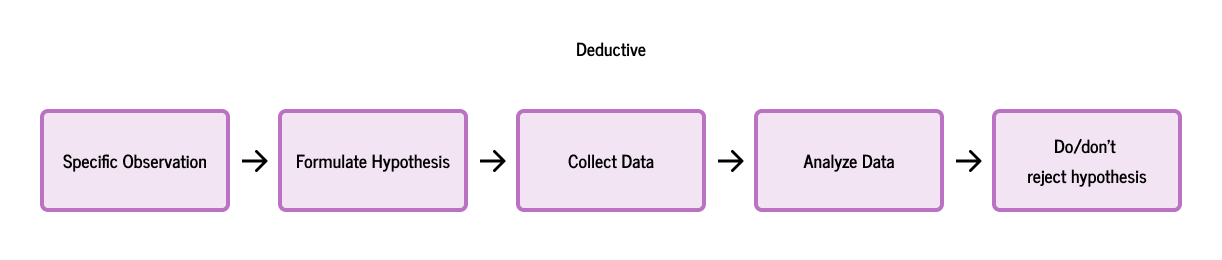
Deductive Reasoning
It’s as simple as like this.
- All men are mortal.
- Socrates is a man.
Therefore, Socrates is mortal.
Inductive Reasoning
Similarly,
- You have seen only white birds.
- You assume all birds are white.
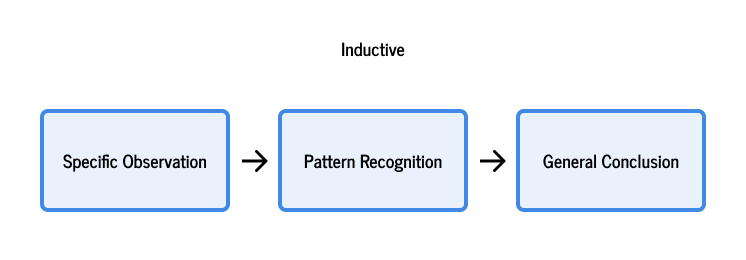
We form opinions through inductive reasoning, but we cannot solely rely on it as it lacks scientific validity. Instead, we need to employ deductive reasoning to our opinions, allowing us to reach conclusions that can be supported or refuted by data.
Why problem-solving is misunderstood?
Problem-solving is a highly sought-after skill in the industry, and research indicates that companies actively seek employees with strong problem-solving abilities.
When we employ inductive reasoning to adapt this skill, we engage in observation and draw a general conclusion. For instance, I have noticed that many individuals in companies tend to disregard the initial signs of a problem, only taking action when the situation worsens. Inductive reasoning stops at the point of realization: “It’s burning.” They may choose to demonstrate their potential or utilize deductive reasoning solely when the problem becomes severe. The higher-level management becomes aware of the serious issues and resolves them, often seeking compensation from the management. This strategy perpetuates a cycle where individuals create problems and are later rewarded for solving them. Unfortunately, when individuals in top management are promoted using similar strategies, they inadvertently reinforce this approach. It becomes a chain of misguided strategies and management failures. It is advisable not to invest your time in such environments.
By applying deductive reasoning the first time we encounter smoke, we have the opportunity to eliminate the risks before a fire ignites. Unfortunately, it is rare to find individuals who employ deductive reasoning and effectively address smoke-related issues within companies. Regrettably, these individuals often remain unknown, unrewarded, and overlooked for promotions or salary increases. They are the unsung heroes who quietly ensure that everything runs smoothly behind the scenes. Instead of recognizing those who act once the fire has started, we should acknowledge and reward these individuals who swiftly disperse the smoke. If you encounter people who appreciate and reward such individuals, and share similar qualities, it is advisable to align yourself with them and combine your strengths. Together, you can achieve remarkable results and create miracles. This is why I believe problem-solving is often misunderstood in our tech industry, and I hope we can bring about change within the industry’s perception and practices.