Oct 22, 2024 / 8 min read
Strategy discipline
Exit Strategy
I guess it’s a pretty common phrase, it’s used in different contexts, but not limited to, from a VC to an investor to an employee. Like everything else that has started beautifully,…

As a science graduate, I’m always impressed by the beauty of nature.
Intro
I guess it’s a pretty common phrase, it’s used in different contexts, but not limited to, from a VC to an investor to an employee. Like everything else that has started beautifully, must end somewhere beautifully. For example, I am an investor in the stock market. Whenever people start complaining about a specific stock, I check the financials, read the last several statements to the public, and guess if it’s the bottom point to buy or not. The goal is to reduce the time to wait with stocks, and find out where it will go up. Just because you bought some stocks, you don’t need to live with them forever. Similarly, you are a VC. You invest in potential ideas, why? You want to maximize the return. When the company grows, the expectation is to go to the public, and get your money back. Imagine from an employee perspective, you found the dream job, got a great environment. As the time passes, you have different expectations. It’s natural, we learned it from Maslow. Every employment journey starts, and unfortunately ends, at a point. That’s the reason of this article, and we will talk about exit strategy for employees today from both employee and manager perspective. Because many individuals don’t know when to quit, and many leaders don’t know when to step in. This post aims to help both sides.
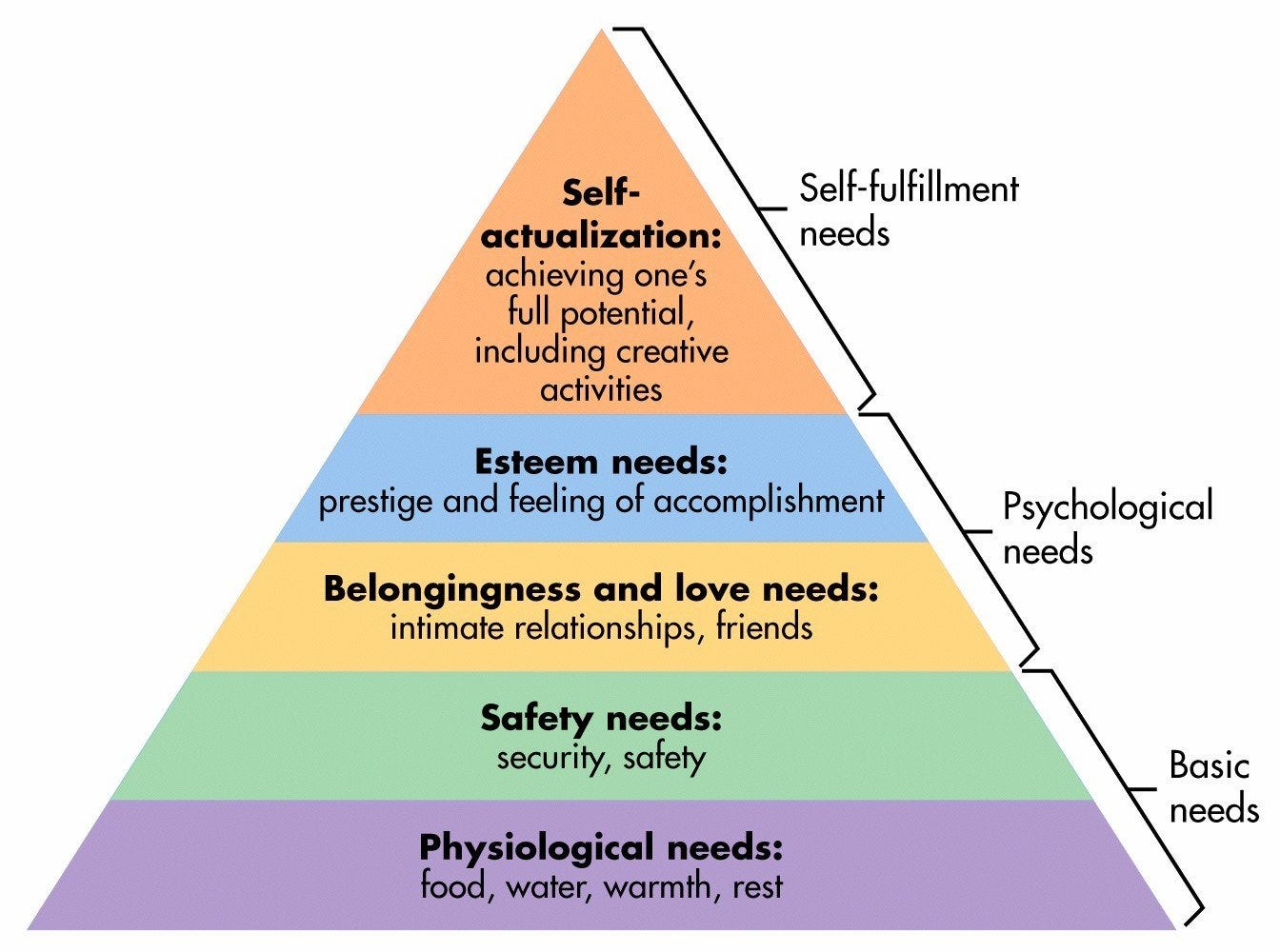
“It is quite true that man lives by bread alone — when there is no bread. But what happens to man’s desires when there is plenty of bread and when his belly is chronically filled?At once other (and “higher”) needs emerge and these, rather than physiological hungers, dominate the organism. And when these in turn are satisfied, again new (and still “higher”) needs emerge and so on. This is what we mean by saying that the basic human needs are organized into a hierarchy of relative prepotency” (Maslow, 1943, p. 375).
Growth Needs
Every individual out there is waiting for the next challenge of their life. The time is constant, but satisfaction of every individual is non-linear. While some are extremely ambitious, some others have a slower pace. It’s also natural. That’s why those, especially in leadership positions, need to understand the needs of their employees and their potential. Then periodically check the satisfaction level of employees. When the employee feels lacking of prestige after his/her accomplishment, as a manager, it’s your duty to feel it. Every individual wants to maximize their impact, or in other words, they want to achieve their full potential. Again, it’s the manager’s duty to enable the employee’s self actualization. As a manager, if you don’t do this, probably you are like any other ordinary manager in the world. None of your employees will remember you, or give you credits at outside. It’s such a shame, but also true that, nobody cares anybody today. So it’s your duty to achieve your full potential. If you don’t need ambitious people, don’t hire them, and then block their future. Check your hiring process and what you need as well.
Effort:Reward Imbalance
This is similar to price:performance ratio at restaurants. How much you pay? Vs how good was the taste? Or how big was the portion? Or how well was the service? Imagine you eat an ordinary döner for 7 euro in Berlin. If another döner shop says 9 euro, what makes their döner 2 euro more expensive? If you are not convinced, you won’t go there any more. Another example from football, there are so many football players who make different amount of money based on their skills. If a player helps you to win the games, that’s a sign, you need to make a better offer to keep the player. What if the player brings typical ordinary skills, that’s what they are paid for. If you are getting crazy why this player cannot score a goal from 5 meters away, that’s the reason. That’s why effort:reward ratio plays a crucial role for employees as well. If you are putting 120%, but getting back 30%, there is an imbalance. Maybe it’s time to document your wins, and discuss your growth. If nothing changes, then start looking for balance where effort matches reward.
How to calculate?
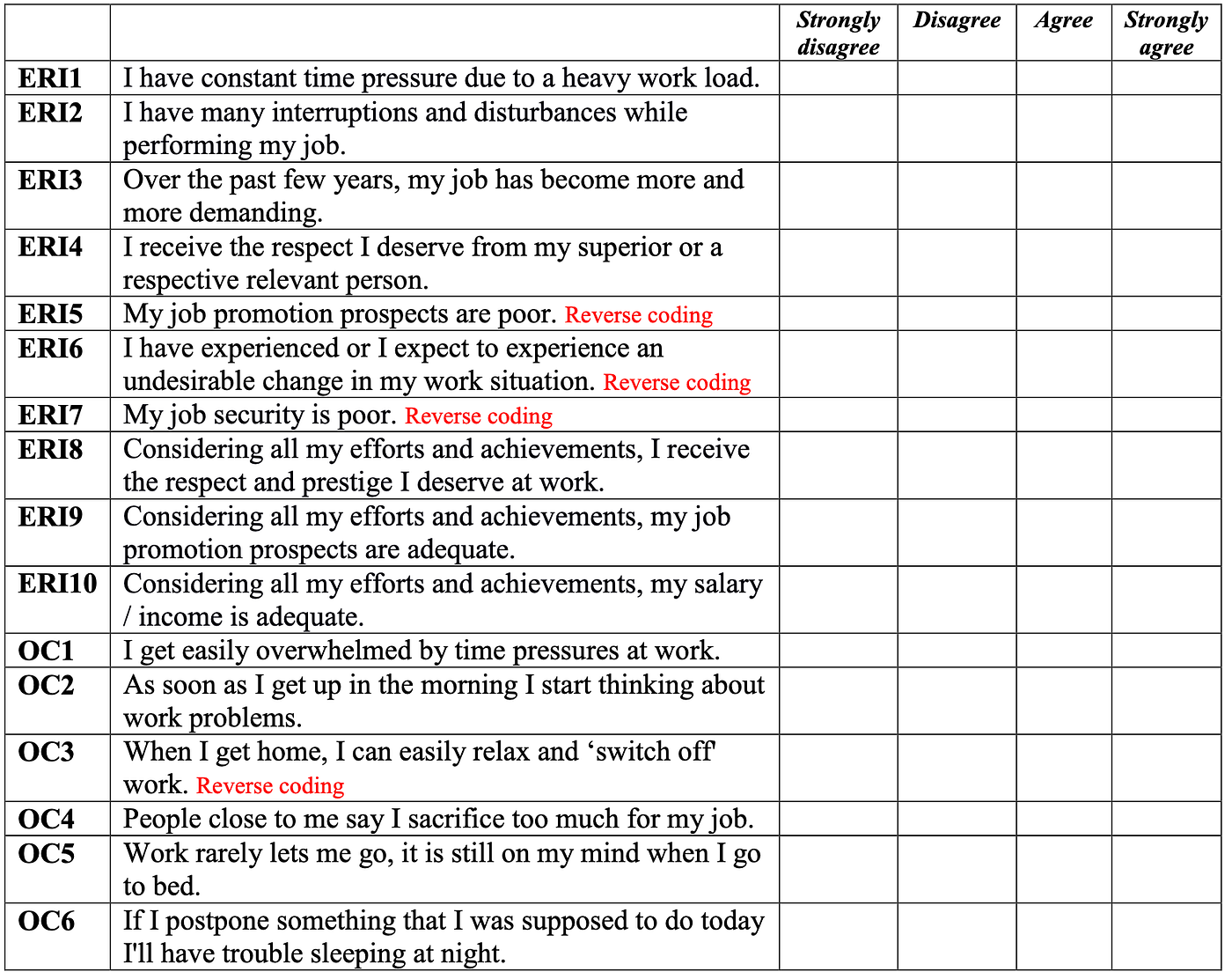
When it comes to calculation, psychologists step in, and give you a questionnaire. We will have a look at short one, you can search and find the long version if you think short is not accurate enough.
Effort Scale
Effort is measured by the first 3 questions and varies between 3 and 12.
Reward Scale
Reward is measured by 7 questions from ERI-4 to ERI-10 and varies between 7 and 28.
Overcommitment Scale
Overcommitment is measured by 6 questions and varies between 1 and 4.
Note: Please pay attention to the reverse coding questions, you need to calculate them from the other way around.
ER Ratio
Long story short, the formula is:
is the correction factor that adjusts for the unequal number of items of the effort and reward scores. For example, if E contains 5 items and R contains 11 items, .
With this formulation, we can interpret ER ratio.
- the person reports one effort for one reward
- the person reports more efforts for each reward
- there are less efforts for each reward
But I suggest not to waste time here to understand formula etc, I suggest now going to ChatGPT, copy and paste the below prompt to quickly take the questionnaire, and get the result.
let’s do the effort reward short questionnaire together, and you calculate the result with the correction factor. ask me one by one.
At the end of the questionnaire, ask further interpretation, please. Evaluate the result with your manager, and ask to change something if the result is not satisfying. If nothing changes, apply exit strategy where effort matches reward.
Work-Life Balance
Hybrid work is an inevitable fact of today. I personally don’t care where employees work as much as they know their roles and responsibilities. As every individual lives a different life, none of the models fit for all employees. There are companies which offer between 100% remote, 100% office. Find one which gives you the flexibility you want.
Dead-End Role
For some people, it’s okay to be in the same position for a long time, maybe a lifetime. But it’s not satisfying for some people. They would like to have a path where they can go forward, but not stuck in the same position. Just remember, everyone can walk around the skirts of Everest mountain, but only few can climb to the top. If you don’t know them, find out what you need for the next steps. If your boss can’t help you get there, find one who will.
Turkish archer Mete Gazoz (22) became the Olympic champion by defeating Italian Mauro Nespoli in the final match of the 2020 Tokyo Olympic Games. How? By setting clear and precise goals.
- To develop shoulder muscles, swimming course,
- To improve coordination skills, played basketball, played piano,
- To be able to see and improve focusing skills, painting course,
- Shot 600 arrows daily, 3500 weekly, 12000 monthly, and 120000 yearly
If you want to be successful, you need a good trainer (manager), discipline and motivation besides your patience. Most of the great results come right after spending minimum, 10000 hours in the job. It’s more or less equal to 5 years if you work 40 hours per week.
No Recognition
You’re doing a great job, but you are not getting the credits you deserve. If this applies to you, you need to develop self marketing skills. If not, you need to find a manager who will not abuse this.
Overload
Most of the time, people who can get things done properly and on time, get more things to do rather than hearing amazing job. Being good at a job doesn’t mean that you have to do everything else. It’s not a compliment, it’s a trap. Push back this kind of tasks by asking to prioritize and/or, use it to ask for more resources for a potential growth path. If the things are piling up and up, then apply exit strategy.
Go-To, not Go-Up
People love it when someone is doing something for them, you become their go-to person. Unfortunately, the hypocrisy of the world is real. When it’s time to get a promotion, you might not be the one who will go-up. If you find yourself in this situation, sorry to say that, but you need to apply for an exit strategy. Because the leadership team overlooks you, you need to find a better place.
Burned Out
You’re overwhelmed with a lot going on, everyone thinks you’re good, but the reality is, you are running on fumes. If this applies to you, use your vacation days to go off, and set boundaries. Sometimes blocking things speed up the resolution. But if the team panics without you, renegotiate your role or apply an exit strategy.
Values
Each company has goals and values which should resonate with employees’ personal values and aspirations. You joined to make an impact, but you feel like you’re just making some numbers. If this applies to you, have an honest talk with your manager about your concerns. If your manager doesn’t get what you are talking about, or answer in the worst possible way, you get the message, it’s time to move out.
Like everything else, a seed naturally grows, but also dies at a specific point. Nothing can go forever linear, but non-linear. Know the limits, not everything is forever. We will die in the end. Do you want to die with your 400 horsepower brain which is used 10% for 40 years at a job which is not satisfying?