Nov 5, 2023 / 9 min read
Strategy discipline
Driving life with mental models
Recently I had a talk on Media and Tech Con at Axel Springer about Mental Models, and how to use them if you want to be not like everyone else.

As a science graduate, I’m always impressed by the beauty of nature…
Background
Recently I had a talk on Media and Tech Con at Axel Springer about Mental Models, and how to use them if you want to be not like everyone else. It was a closed group session, so I’d like to share key takeaways here.
Mental Models are part of our lives if we get the concept correctly. You might also need to change the way you look at the world, because we will look at how the things work at the World.
Acquiring Wisdom
What do you do every day to get smarter? It’s tough. Maybe we should spend at least 4 hours every day to read what’s happening at the outside of our world. Because we live in a world in which we don’t fully understand how the things work. We know very few people, and therefore we have a very narrow worldview. Charlie Munger explains his approach in a single sentence:
I believe in the discipline of mastering the best of what other people have figured out.
~Charlie Munger
To be able to understand what other people have figured out, I started to read books. It’s also difficult to find out what to read, because not all the books deserve to be read. It was not that easy in the past to write a book, and publish it. Today it’s like a baby toy, everyone is writing a book, and the value of books started to reduce. If you look at the older books, you will see that they are more comprehensive than today.
What’s Mental Model?
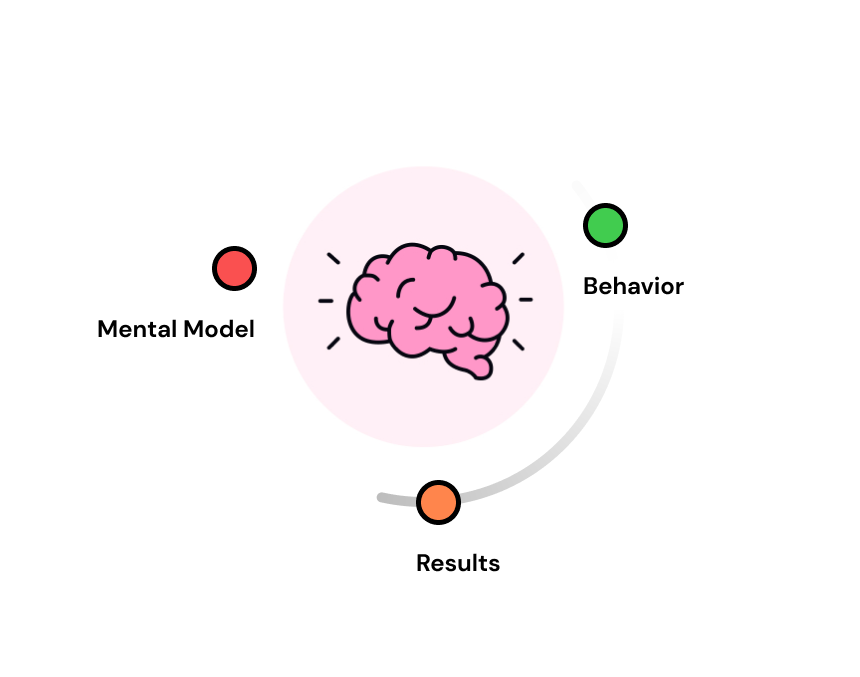
A mental model is an explanation of someone’s thought process about how something works in the real world. It is a representation of the surrounding world, the relationships between its various parts, and a person’s intuitive perception about their own acts and their consequences.
The First Flaw: Perspective
Perspective is the number one blocker to develop mental models. We have a very narrow world-view. Because we cannot study the world in a single book, that’s the reason educational system divides it into different disciplines e.g. math, science, history… When someone completes a level of math, the person is good at solving problems and calculations, but lacks of science and history… Life is full of struggles when you are alone. We need other people, we need to understand each other, we need to collaborate…
When you change the way you look at things, the things you look at change.
~Max Planck
The Second Flaw: Ego
Be the fool, ask the silly questions, and kill your ego. Stay humble!
Through my career, I was involved in so many interesting situations, and conversations. What I have observed so far is, somehow people start a title war in companies when they are insecure in their position. Life is a good teacher if you are open to its feedback. So I learned a micro lesson here. I decided to avoid this kind of harsh conversations in the future. Since that time, I’m not using any title, any seniority tag, only #product, and it’s enough. I help companies to develop products customer love. That’s it.
Ego is also important, you can’t stay humble all the time. Someone has to invent the car, space rocket, vaccines.
The Third Flow: Distance
In life, you have to face consequences of your actions. In business, consequences falling on the shoulders of someone above you and by not immediate action-reaction system the mistakes are being diminished.
When you touch a hot stove, the first reaction is to pull back your hand. Then you learn a micro lesson here, and create a generalized concept. Before touching anything else, you check whether it’s hot or not. Then it becomes a mental model.
Unfortunately, understanding how the things work in life is not enough. When you develop the mental model like in the above example, you have to adjust your behavior. Because human is a pain-avoiding creature. As long as the things cause pain on us, we show intention to solve it. Again unfortunately, even if we know that it was a clear mistake at micro level, people create a narrative, and find themselves right at macro level. That’s why they don’t solve the problem, don’t create a concept, and a mental model. Later, the result is unavoidable. You repeat the same action, and get the same result.
A man who has committed a mistake and doesn’t correct it,
is committing another mistake.
~Confucius
Circle of Competence
We live in a world, which is complex, and each of us study, learn something else. Then gets expertise in very specific fields. We are feeling very strong in our special fields, but we must respect the other fields when it comes to collaboration, and let them do their work. Never overstep other people, and make decision on behalf of them. Because they are expert in their own field, you are not. That’s the reason Tom Watson says the following:
I’m no genius, but I’m smart in spots, and I stay around those spots.
~Tom Watson
For example, some time ago, I decided to buy a couch to chill, and have an option to host my guests when they visit me. Unfortunately, I’m not a sofa expert. I have very limited understanding when it comes to furniture. So I have to work with people who have better experiences here. Finally, I made a decision to buy L shape sofa which can be transformed into a bed, has a storage space, 5 additional pillows on it, cover can be removed and washed in washing machine. I didn’t receive the sofa yet, but as long as it’s comfortable, I’ll be happy with the selection.
First Principles
Here I’ll share the example from Tesla. Elon Musk also emphasized it in a YouTube video. We all know that Tesla wasn’t even a car manufacturing company. First time they developed a car, and it was an electrical one. Generally speaking, when you want to prepare a food, you generally have intention to buy ingredients instead of buying a farm, and start planting the vegetables you need. It’s similar to Tesla. They started to buy main pieces, and combine them. This is also how we develop software products. We don’t develop everything in house.
Most geniuses — especially those who lead others — prosper not by deconstructing intricate complexities but by exploiting unrecognized simplicities.
~Andy Benoit
Next step, Tesla evaluates the car. It costs 50k, and they sell it for 80k. So they make 30k profit for each car sale. Numbers are randomly written, away from reality. I just want to make things clear for everyone. They start evaluating the cost of pieces in a Tesla car, and see that the battery is the most expensive part. So they start focusing on how to make it cheaper. Start generating ideas e.g. battery is made of element X, Y, Z. What if we buy element X from country A, element Y from country B…, and combine them in the factor? Overall cost is reduced 20%. How many batteries do we need within the next 5 years? Potentially, how much money we save?
When we follow this way to question the status quo, we keep improving our lives, and products we develop. This improvement is later used to gain competitive advantage in the market. If you keep making 30k profit from each car, and you stop improving it, probably there will be a new car manufacturer soon, maybe you will need to shut down your business.
Second Order Thinking
In second-order thinking, individuals take into account the potential indirect and longer-term consequences, as well as the potential unintended outcomes of their decisions. They consider multiple variables, scenarios, and interactions to gain a deeper understanding of the complexity involved.
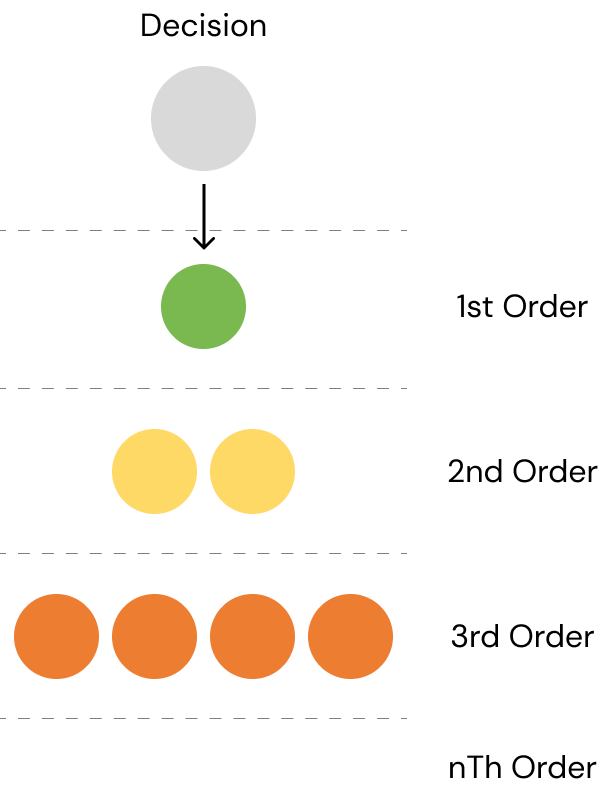
Imagine you have an idea, and if you execute the first thing comes to your mind, probably you will get the same result as everyone else. To be a unique somebody, you need to think about the pros and cons of the decision, and then try to eliminate the risks for each option.
For example, some time ago in one of the countries, a mayor is tired of rats in the city, and was looking for an option to solve the problem. The mayor decided to announce a bounty program. Bring a dead rat, get some money. Sounds good, and simple. Initial results are also successful. Number of rats are reduced, streets are getting safer, cleaner. But we have a problem. The mayor get dead rats every day after months. Because people converted the problem into a business. They breed the rats, and bring a few every day to get some money. The mayor makes another quick decision, and cancels the program. Then people release their useless rats to the street, and problem keep going on and on. If the mayor applied the second order thinking to the problem, probably the solution would be different, and better.
Inversion
Involves considering the opposite or reverse of a situation or problem. By focusing on what to avoid or what not to do, one can gain a clearer understanding of the problem and find better solutions.

Imagine you want to live a healthy life. Now you ask yourself what to do to live a healthy life. Then find answers:
- Do exercise
- Pay attention to diet.
Now let’s reverse the situation. What not to do to live a healthy life?
- Inactive lifestyle
- Not drinking enough water
- Not sleeping enough
When we reverse the situation, we get different answers to our questions. Because happy path (doing exercise and having a good diet) is not enough to have a sustainable healthy life.
The Power of Acquiring New Models
I often see people, they believe everything they see on the internet, and accept it as a proof of something else. We have to question everything. We simply cannot say, this is the defined workflow for us. We have to follow it until we die. Almost everything has contextual validity, and based on some variables. One of the variable is time. When time changes, truth might change as well. That’s the reason famous physicist Richard Feynman also complained about it.
I don’t know what’s the matter with people: they don’t learn by understanding, they learn by some other way — by rote or something. Their knowledge is so fragile!
~Richard Feynman
In this post, I introduced mental models, how to use them, what blocks us to develop them. Next post, I’ll explain the mental models of successful software product development, and how to be a disruptor company in the competitive market.