Feb 9, 2025 / 5 min read
AI systems
AI & Democracy
I spent a week at the Lisbon Web Summit in late 2024. As someone who hasn’t networked extensively before, this was a rare opportunity to connect with and learn from so many people,…

As a science graduate, I’m always impressed by the beauty of nature.
Lisbon…
I spent a week at the Lisbon Web Summit in late 2024. As someone who hasn’t networked extensively before, this was a rare opportunity to connect with and learn from so many people, particularly those in the tech industry. On my flight back to Berlin, I reflected on the experience and decided to share some key takeaways in a LinkedIn post.
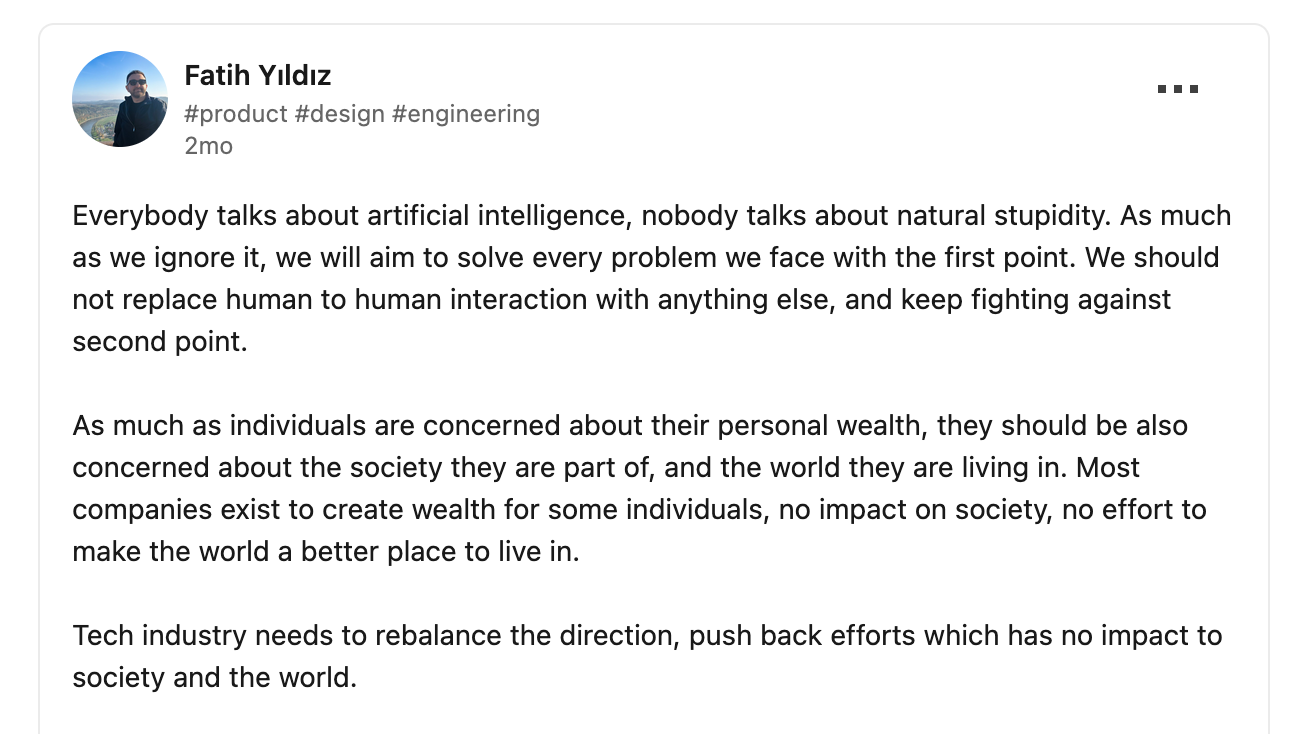
Developing mental models from the vast amount of information available takes considerable time and effort. However, my recent trip to Lisbon accelerated this process somewhat. The world already feels like it’s in a state of turmoil, and the future for humanity appears uncertain. Let me share some key historical events that have shaped our present and may influence our future.
Post Social Media Era ~2000
Technological advancements led to the rise of social media, where people connect, share their feelings, and express opinions (within certain boundaries). I joined in, creating accounts and even sharing my Winamp playlists with friends on Messenger. Attempts to regulate this space haven’t been very successful. Dissenting voices are often silenced, and tech companies and politicians leverage their influence to manipulate public opinion, ultimately harming democratic processes.
This era seems to be eroding people’s critical thinking skills. We appear to be getting less intelligent, and this decline in intellect is becoming obvious. Some governments exploit this trend as a tool for control, maintaining their power.
Post Covid Era ~2020
Central banks’ massive money printing during the COVID pandemic sparked global inflation. Some countries, like Turkey, experienced particularly dramatic inflation spikes. Other nations, with more accumulated wealth, managed to mitigate the impact by distributing resources to their populations.
Those with limited financial literacy, typically poorer individuals, often lack the means to build wealth or manage their finances effectively. Even if they possess some financial knowledge, their primary concern is meeting basic needs. Consequently, they spent the newly available money on essential goods and services, which, in turn, further enriched the already wealthy.
Politics, Economy, and Technology
Politics, economics, and technology form a complex, interconnected system. Finding a balance within this system is crucial for creating a peaceful world, but historical and current events make this a difficult challenge.
My hope for technology is that it serves humanity by simplifying lives, solving problems, and ultimately empowering individuals. However, the reality is far different. Humans primarily use technology for entertainment, leading to an explosion of entertainment options, from movies and music to dance videos. This excessive focus on entertainment is a dangerous trend, rapidly diminishing our intellectual capacity.
The global economy presents another significant challenge. Wealth creation should be accompanied by equitable distribution across all segments of society. We cannot afford to leave any group (genders, ethnics, education etc.) behind, as has happened historically with women and continues to some extent today. While progress has been made, we still need to advance both in creating wealth and ensuring its fair distribution. Achieving this requires providing equally good job opportunities. As long as disparities exist in the quality of jobs, economic inequality will persist. This is actually an essential piece of building a peaceful society, and world.
While the concept of taxing the wealthy to support society is well-intentioned, it’s not a long-term solution. Sustainable societal well-being requires that everyone have access to meaningful employment. Otherwise, the wealth gap widens, leaving governments with insufficient funds to redistribute. This inability to share resources can breed social unrest. The key is creating good job opportunities so individuals can become self-sufficient and lessen their reliance on government support.
Post AI Era ~2025
The apparent decline in critical thinking skills, coupled with a lack of any significant effort to reverse this trend, is concerning. This trajectory raises the very real possibility of artificial general intelligence surpassing human capabilities, potentially rendering us obsolete. The current push to replace human labor with AI, combined with the seeming disinterest in bolstering human intellect, makes this outcome seem increasingly likely. To avoid this, a concerted effort to upskill the human population is crucial. The critical question, however, remains: who will champion this vital undertaking?
The decline in critical thinking skills, mentioned earlier, is becoming increasingly relevant as AI’s prominence grows. Employers are naturally exploring how to leverage AI, given the inherent limitations of human intelligence. It’s important to remember that while humans created AI, it wasn’t a collective effort. Rather, a select group of individuals developed it, potentially with the aim of surpassing the capabilities of the broader population.
AI’s increasing influence will significantly reshape the job market, inevitably leading to job displacement and the emergence of new roles. Adaptation is key, and this requires effective people management focused on continuous upskilling. Without this, widespread unemployment and increased reliance on government support are likely, exacerbating the wealth gap and potentially creating a scenario where the rich get richer and the poor get poorer. As previously stated, this poses a substantial risk to humanity’s future.
While some employers tout AI’s potential to enhance human work, it’s likely that a larger motivation is cost reduction through automation. The drive to accomplish more with fewer resources is a common business objective. Given AI’s inevitable advancement (driven not only by development, but also by the relative decline in human critical thinking skills, and the fact that AI can now self-improve), widespread job automation and potential wage suppression are highly probable. This will further exacerbate income inequality, creating increasingly distinct wealth classes and negatively impacting the overall economy.
Given the potential consequences discussed, global AI policies are essential to mitigate widespread economic disruption. While this sounds ideal, the reality is likely to mirror the post-social media era. Instead of collaborative regulation, we’ll likely see a race where companies and politicians leverage AI for competitive advantage, neglecting the need for policies that address AI’s potentially harmful societal effects.
To reiterate the initial point, while the focus in Lisbon and elsewhere is often on wealth creation for a select few, the tech industry needs a fundamental shift in priorities. The emphasis should be on addressing humanity’s challenges, improving lives, and making the world a better place. The current trajectory is ultimately detrimental to us all.
In summary, the decline in human critical thinking, coupled with the rapid advancement of AI’s reasoning capabilities and its use in automation, is exacerbating income inequality. The lack of effective upskilling initiatives and the prevalence of self-serving politicians are jeopardizing democracies.